Description
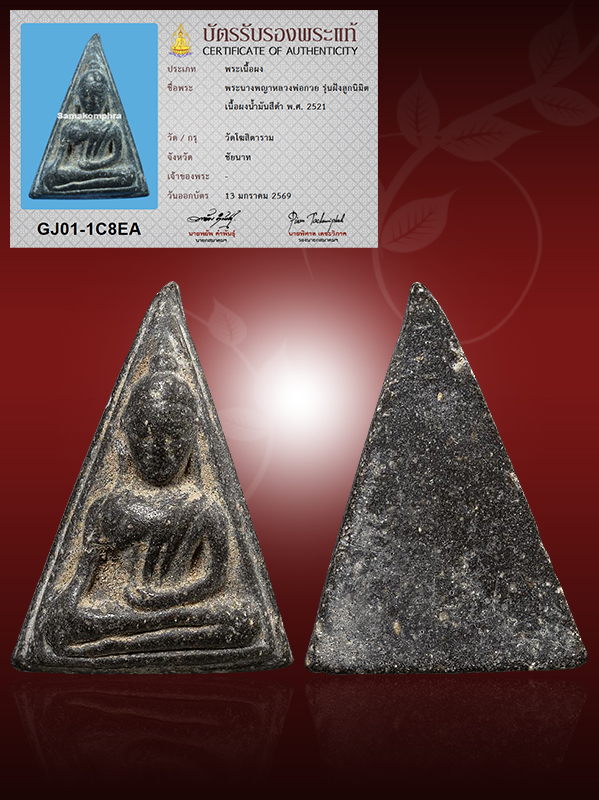
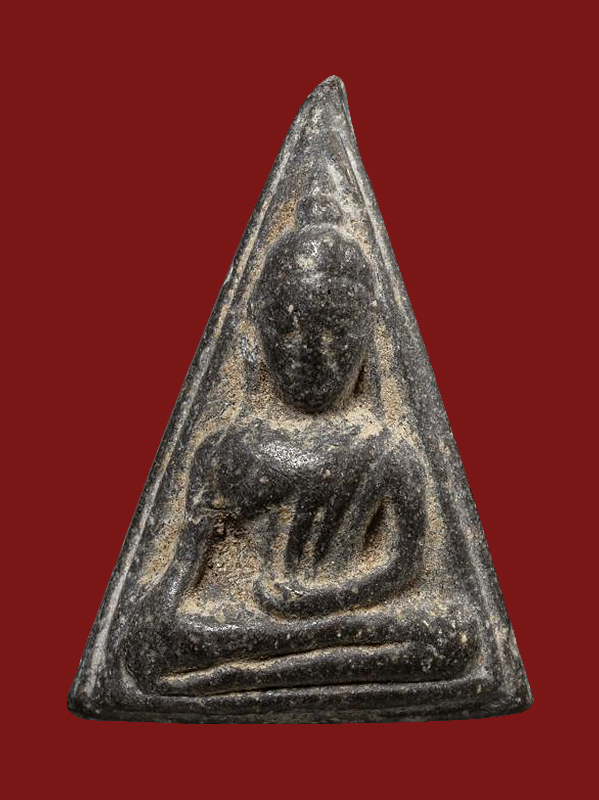
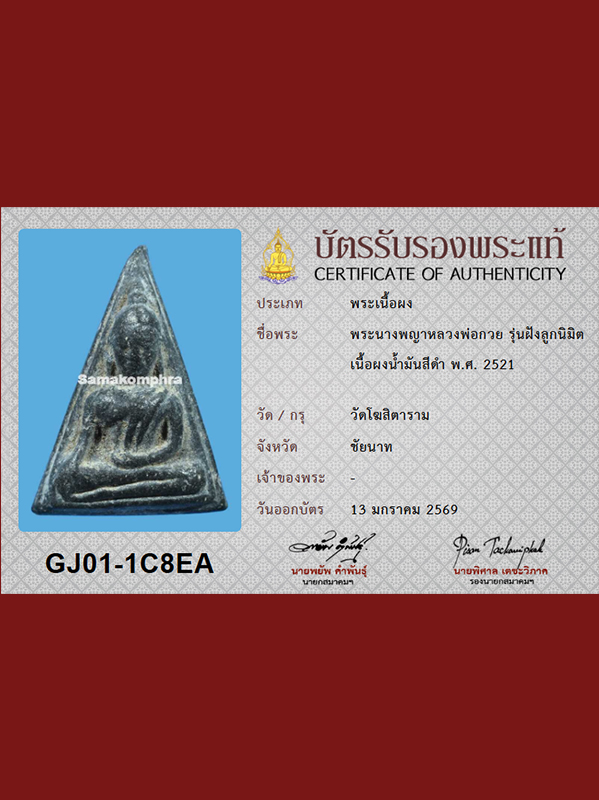
Phra Nang Paya Lp Kuay Wat Kositaram B.E.2521 with SMK cert
- Made of Bailan (Sacred powder mixed with sacred manuscript)
- Nice condition
- Rare than normal sacred powder
- With SMK cert
- Guarantee real 100%
**Information on the Creation of Phra Nang Phaya, Luang Pho Kway, Wat Khosittharam, Year B.E. 2521**
Phra Nang Phaya created by Luang Pho Kway Chutinthonro at Wat Khosittharam, Chai Nat Province, was made in B.E. 2521 (1978) during the occasion of burying the boundary stones (luk nimit) and consecrating the ordination hall boundary (phuk phatthasi ma). This is the same batch as the coin with Hanuman on the reverse.
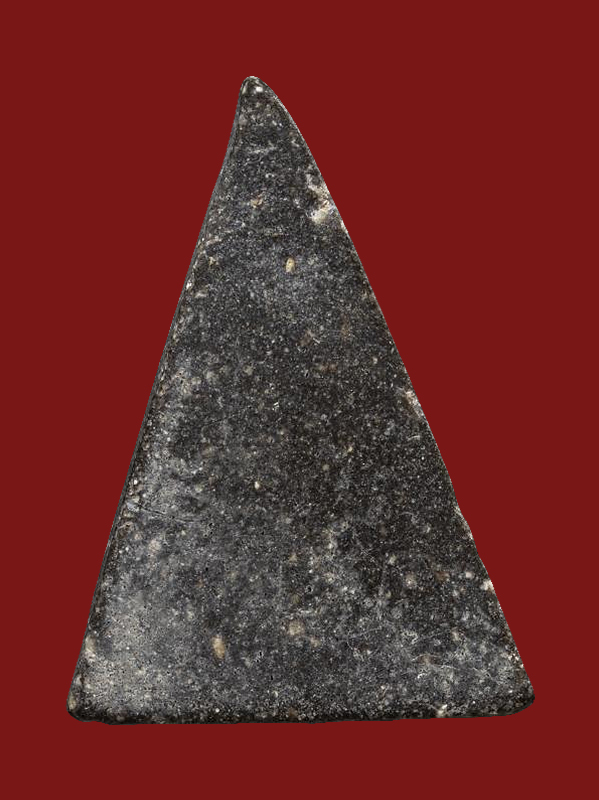
Luang Pho Kway personally created and produced the amulets. The size is approximately 3.2 × 2.5 cm, suitable for casing and wearing around the neck. There are several molds such as large mold, small mold, base-line mold, big-head mold, pillow-base mold, and standard mold (seated Buddha with hands touching knees). Some pieces have a yantra on the back, some have a plain back, and some show fingerprint marks from pressing the mold.
### Creation and Main Materials
Luang Pho Kway preferred to make amulets himself, especially powder and clay materials, with high attention to detail. He pressed each Somdej mold by hand one by one. Clay molds were often taken from old pieces; if the impression was unclear, he would keep them with the clear ones or discard them into the pond. The 9-leaf Bodhi leaf mold front was preserved by Ajarn Tua, who later produced and distributed amulets but changed the yantra on the back. Unattractive clay molds were kept by Dr. Chaleo Detma.
Production involved hand-pressing, resulting in natural fingerprint marks and slanted cut edges on some pieces. The materials were mixed with special minerals and sacred powders made by Luang Pho Kway himself. Some molds contain hair from Luang Pho Kway or other highly virtuous teachers. Special minerals were sourced from Don Chedi, the ancient city of Sukhothai, and Mae Moh mine in Lampang Province (entered after the mine was closed by speaking with the guard). These minerals are still stored in the temple museum cabinet; the last batch was brought with Dr. Chaleo Detma.
Sacred powder was made from two-pore soil mixed with medicines that Luang Pho Kway consecrated himself, sprinkled with holy water, and some ingredients were specially obtained. The medicines for making “din so” powder (used in Pathamang powder) included all five types of Chan flowers, Rajapruek leaves, white mamuang seeds (grown by himself), and the five “dee” ingredients such as dee ngu (snake), dee kai (chicken), dee tao (turtle), which Luang Pho Kway had consecrated for hanging in homes to dispel heavy curses. The wooden clapper stick was struck on a bell first, then ground and mixed with other powders to make din so powder.
For the 9-leaf Bodhi mold, hair from highly meritorious persons was also mixed in.
### Consecration
Luang Pho Kway personally consecrated the medicines and materials. For din so powder, two-pore soil was mixed with consecrated medicines and powders sprinkled by Luang Pho Kway, resulting in visible sacred powder particles and lines in the material. It was a major consecration ceremony.
### Materials
– Powder oil material (sometimes called black oil powder or oil powder + bai lan) – shows sacred powder particles and natural aging marks.
– Bai lan leaf powder – old texture with cut marks.
– Clay material (mostly red clay, about 80% clay) – glossy surface when touched, with natural fingerprint marks and patterns.
### Powers (Phutthakhun)
Renowned for: metta maha niyom (great loving-kindness and immense popularity), maha amnat (great authority), wasana (great charisma and good fortune), klaew klad plod phai (invulnerability and protection from danger), good for business and trade, gaining favor from superiors and elders, enhancing overall prosperity and preventing downfall.
**關於 龍婆乖 Wat Khosittharam 寺廟 製作的 Phra Nang Phaya(พระนางพญา)資訊,佛曆 2521 年**
龍婆乖(Luang Pho Kway)Chutinthonro 在泰國猜納府(Chai Nat Province)Wat Khosittharam 寺廟製作的 Phra Nang Phaya,是在佛曆 2521 年(西元 1978 年)為埋設界石(luk nimit,ลูกนิมิต)及結界 ordination hall(ผูกพัทธสีมา)而製作的批次。此批次與背面為哈奴曼(Hanuman)的硬幣屬同一批次。
龍婆乖親自製作並生產這些佛牌。尺寸約 3.2 × 2.5 厘米,適合包嵌後掛頸佩戴。模具有多種,例如大模具、小模具、底線模具、大頭模具、枕頭底模具,以及標準模具(坐姿佛像,雙手觸膝)。部分佛牌背面有 yantra(符咒),部分背面平滑,有些可見因壓模而留下的指紋痕跡。
### 製作與主要材料
龍婆乖偏好親手製作佛牌,尤其是粉末與黏土材質,並極為注重細節。他親手一顆一顆壓製 Somdej 模具。黏土模具通常取自舊佛牌;若壓印不清晰,他會將其與清晰的放在一起,或丟入池塘。9 葉菩提葉模具的正面由 Ajarn Tua 保存,後來他生產並分發佛牌,但更改了背面的 yantra。不美觀的黏土模具由 Dr. Chaleo Detma 保存。
製作過程採用手工壓模,因此部分佛牌會有自然的指紋痕跡及斜切邊緣。材料混合了龍婆乖親自製作的特殊礦物與神聖粉末。有些模具中含有龍婆乖或其他高功德師父的頭髮。特殊礦物來自 Don Chedi、素可泰古城,以及 Lampang 府的 Mae Moh 礦場(礦場關閉後,透過與守衛交談進入)。這些礦物至今仍保存在寺廟博物館櫃中;最後一批由 Dr. Chaleo Detma 帶來。
神聖粉末由兩孔土壤混合龍婆乖親自加持的藥材製成,並灑上聖水,有些成分是特別取得的。用於製作「din so」粉末(用於 Pathamang 粉)的藥材包括五種 Chan 花、Rajapruek 葉、白芒果種子(自行種植),以及五種「dee」成分,例如 dee ngu(蛇)、dee kai(雞)、dee tao(龜),這些均由龍婆乖加持,用於掛在家裡以破除嚴重詛咒。木製擊鐘棒先敲擊鐘後再磨碎,混合其他粉末製成 din so 粉。
9 葉菩提模具中,還混入了高功德人士的頭髮。
### 加持儀式
龍婆乖親自加持藥材與材料。din so 粉末使用兩孔土壤混合加持過的藥材及龍婆乖灑下的粉末,因此材質中可見神聖粉末顆粒與線條。這是一場大型加持儀式。
### 材質
– 油粉材質(有時稱黑油粉或油粉 + ใบลาน)——可見神聖粉末顆粒與自然老化痕跡。
– ใบลาน 葉粉材質——老舊質感,帶有切割痕跡。
– 黏土材質(大多為紅黏土,約 80% 黏土)——觸摸時表面光滑,帶有自然指紋痕跡與紋理。
### 佛力(Phutthakhun)
以以下功效聞名:metta maha niyom(極大慈悲與極高人緣)、maha amnat(極大權威)、wasana(極大福報與好運)、klaew klad plod phai(避險與免於危難)、生意興隆、貿易順利、獲得上級與長輩喜愛、提升整體運勢與繁榮,並防止衰敗。